1. Wi-Fi® jest zarejestrowanym znakiem towarowym będącym własnością organizacji Wi-Fi Alliance®.
2. Wi-Fi® is a registered trademark of Wi-Fi Alliance®.
Weighing Tables
RADWAG weighing tables provide a stable, vibration-isolated base for balances, which is a condition for reliable results – especially when weighing with a readability of 0.01 mg or better. The range includes antivibration tables for laboratory balances, industrial scales, mass comparators, automatic feeders and pipette calibration devices, as well as professional weighing workstations PSW and PSW/DUAL with space for a computer and UPS. The tables are made of powder-coated steel or AISI 304 stainless steel with a heavy stone or granite top. All products are designed and manufactured by RADWAG in Poland.
Why does a balance need a weighing table?
Every building vibrates – because of traffic, lifts, ventilation, machines or people walking. For a standard table these vibrations are imperceptible, but a microbalance or analytical balance registers them as an unstable result, a longer stabilisation time and worse repeatability. An antivibration table separates the balance from the surroundings: the heavy stone on which the balance stands rests on vibration dampers and is not connected to the outer frame of the table. Leaning on the worktop, writing or placing accessories therefore do not affect the measurement.
RADWAG weighing tables
| Model | Dimensions L × W × H | Load capacity | Construction | Purpose |
|---|
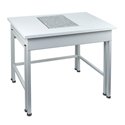
| SAL/C, SAL/H | 770 × 680 × 815±10 mm | 40 kg | powder-coated steel with MDF top (C) or AISI 304 stainless steel (H), stone in the centre | microbalances, analytical balances and other laboratory instruments |
| SAL/C/PLUS, SAL/H/PLUS | 770 × 680 × 815±10 mm | 40 kg | powder-coated steel (C) or AISI 304 stainless steel (H), stone in the centre | PLUS series laboratory balances |
| SAL/STONE/C, SAL/STONE/H | 1000 × 650 × 815 mm | 150 kg | powder-coated steel (C) or AISI 304 stainless steel (H), large stone top, net weight 215 kg | several balances on one table |
| SAP/C, SAP/H | 770 × 650 × 815±10 mm | 40 kg | powder-coated steel with MDF top (C) or AISI 304 stainless steel (H), large stone top | industrial and precision scales |
| SA/APP/C, SA/APP/H | 710 × 470 × 225 mm | 150 kg | powder-coated steel (C) or AISI 304 stainless steel (H), massive granite plate, anti-slip protection of the stone | mass comparators – low design makes it easier to load heavy weights |
| SAL/T | 770 × 650 × 815±10 mm | 40 kg | powder-coated steel, HPL top, stone on the left side | PA-04/H automatic feeder |
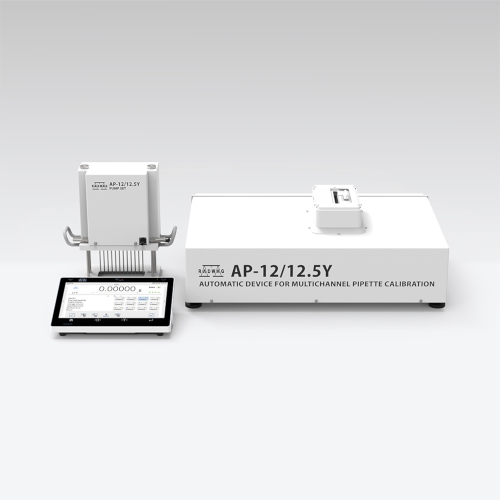
| Antivibration table for pipette calibration | 1500 × 800 × 800±100 mm | 50 kg | powder-coated steel, HPL top, granite, feet adjustable up to 10 cm | AP-12/12.5Y automatic device for multichannel pipette calibration |
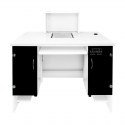
| PSW | 1100 × 750 × 1100 mm | – | steel structure, stone top, MDF working part, 2 lockers for PC and UPS, keyboard shelf, monitor base | 1 microbalance or analytical balance with a computer |
| PSW/DUAL | 1350 × 750 × 1100 mm | – | as PSW, with two stone tops | 2 balances working simultaneously |
Antivibration tables and weighing workstations
- Laboratory antivibration tables SAL – two independent structures: an outer one with a worktop and an inner one with a stone on a vibration damper. The stone is located in the centre of the table, and the feet with rubber tips allow levelling on an uneven floor. Versions for any laboratory balance (SAL) and dedicated to PLUS series balances (SAL/PLUS).
- SAL/STONE tables – a large, heavy stone top (table net weight 215 kg, load capacity 150 kg) on which several balances can be placed at the same time.
- Industrial antivibration tables SAP – with a large stone top, designed for industrial and precision scales.
- Tables for mass comparators SA/APP – low (225 mm) with a massive granite plate, load capacity 150 kg and protection against the stone slipping. They are used for mass comparators and the calibration of mass standards.
- Dedicated tables – SAL/T for the PA-04/H automatic feeder and an antivibration table for the AP-12/12.5Y multichannel pipette calibration device (1500 × 800 mm, height adjustable within ±100 mm).
- Professional weighing workstations PSW and PSW/DUAL – complete workstations for one or two balances, with a separated antivibration part, lockers for a computer and UPS or power strip, a sliding keyboard shelf, a monitor base and ventilation openings.
C and H versions – which material to choose?
Most tables are available in two versions. The C version has a powder-coated steel structure and an MDF or HPL worktop – it is a good choice for typical laboratories and quality control rooms. The H version is made of acid-resistant AISI 304 stainless steel, which is resistant to corrosion, disinfectants and chemicals and is easy to clean. It is recommended for pharmaceutical, microbiological and chemical laboratories and for cleanrooms.
Applications of weighing tables
- laboratories – workstations for microbalances, ultra-microbalances and analytical balances,
- pharmaceutical and chemical industries – stainless steel tables that are easy to disinfect,
- calibration laboratories – stable bases for mass comparators and mass standards,
- pipette calibration – a dedicated table for an automatic calibration device,
- quality control – precise weighing near production lines, where the floor transmits vibrations from machines,
- automated workstations – tables for balances with automatic feeders.
How to choose a weighing table?
- Type of balance – SAL for laboratory balances (SAL/PLUS for the PLUS series), SAP for industrial scales, SA/APP for mass comparators, SAL/T for the PA-04/H feeder.
- Number of instruments – one balance: SAL or PSW; several balances on one top: SAL/STONE; two workstations with computers: PSW/DUAL.
- Load – most tables carry 40 kg; SAL/STONE and SA/APP up to 150 kg.
- Environment – C version (powder-coated steel) for typical rooms, H version (AISI 304 stainless steel) where chemical resistance and easy cleaning are required.
- Workstation equipment – if the balance works with a computer, printer or UPS, choose a PSW workstation with lockers and a keyboard shelf.
FAQ – weighing tables
How does an antivibration table work?
The table consists of two independent structures. The outer one, with the worktop, is where the operator works; the inner one carries a heavy stone on vibration dampers, on which the balance stands. Because the two parts do not touch, vibrations from the floor and from the worktop are not transmitted to the balance.
Which balances need an antivibration table?
Above all microbalances, ultra-microbalances and analytical balances, as well as mass comparators – instruments with a readability of 0.1 mg or better, for which even slight vibrations extend the stabilisation time and worsen repeatability. A table is also recommended for precision balances in rooms with heavy traffic or near machines.
What is the difference between the C and H versions?
The C version has a structure made of powder-coated steel and an MDF or HPL top. The H version is made of AISI 304 acid-resistant stainless steel, which is resistant to corrosion and disinfectants – it is chosen for pharmaceutical and chemical laboratories and cleanrooms.
Can several balances be placed on one table?
Yes. The SAL/STONE table has a large stone top measuring 1000 × 650 mm with a load capacity of 150 kg, so several balances can work on it simultaneously. For two separate workstations with computers, the PSW/DUAL workstation is available.
What is a professional PSW weighing workstation?
It is a complete workstation for a microbalance or analytical balance: a steel table with a separated antivibration part and stone top, lockers for a computer and a UPS or power strip, a sliding keyboard and mouse shelf, a monitor base and ventilation openings. The PSW/DUAL version has two stone tops for two balances.
Is the table suitable for an uneven floor?
Yes. RADWAG tables have adjustable feet with rubber tips that allow the table to be levelled on an uneven floor. The table for the pipette calibration device has feet adjustable by up to 10 cm.
Setting up a weighing room or laboratory? Contact our specialists – we will help you choose the table, balance and accessories, and provide technical support.









 AS X7 Analytical Balances
 Moisture Analyzers
 PGC Scales
 Checkweighers
 HRP High Resolution Scales
 Hazardous Area Endangered with Gas Explosion
 Hazardous Area Endangered with Gas and Dust Explosion
 H315 H Waterproof Platform Scales




 5Y Terminal
 PUE CY10 Weighing Terminal
 PUE H315 Weighing Terminal
 PUE C315 Weighing Terminal
 R Terminal (WDM-8)
















 Albanian
 Danish
 Nederlandse
 Estonian
 Finnish
 Hungarian
 Icelandic
 Kazakh
 Latvian
 Lithuanian
 Macedonian
 Norwegian
 Portuguese
 Romanian
 Russian
 Slovak
 Slovenian
 Swedish
 Ukrainian
 Serbian
 Montenegrin
 Português (Brasil)
 Deutsch
 Español
 Français
 Italiano
 Japanese (日本語)
 Polski
 Türkiye
 Česky
 中文


